
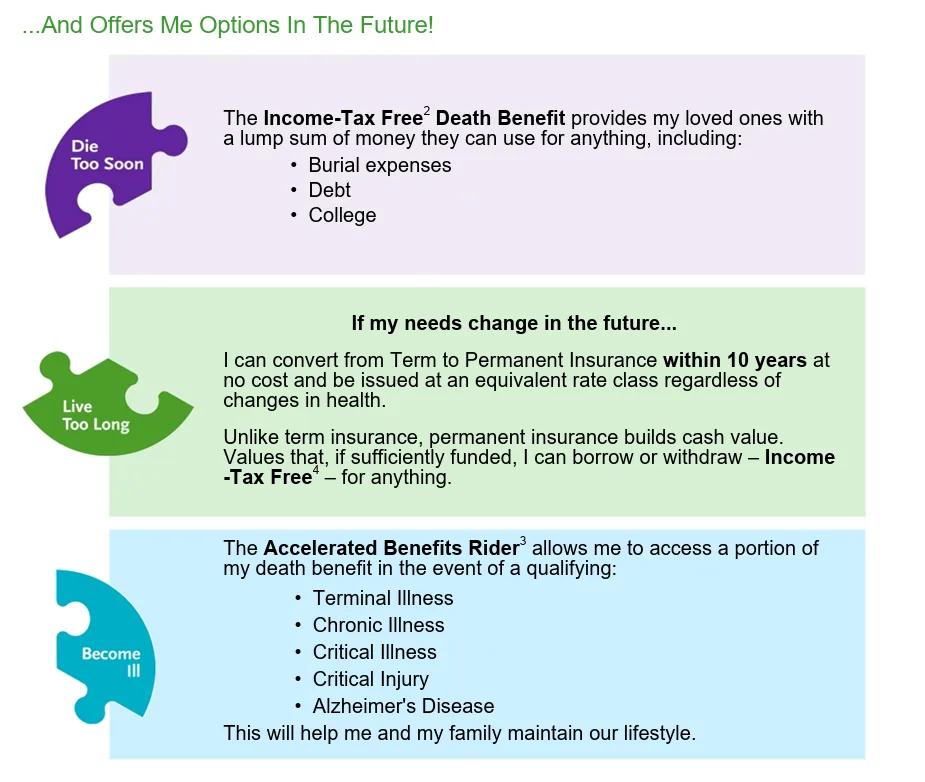
“Living benefits” is the everyday name for accelerated benefit riders: clauses on a life insurance policy that let you receive part of your own death benefit while you are alive, if you are diagnosed with a qualifying condition. Most people who own life insurance do not have them, and most of the people who do have never read what they say. This is the plain version.
Terminal illness
The oldest and most common rider. If a physician certifies that an illness is expected to result in death within a set period — 12 months with most carriers, 24 with some — you can accelerate a large share of the death benefit, usually paid as a single lump sum. The money is unrestricted. People use it for treatment, for travel, to pay off a mortgage, or simply so that the last year is not also a financial emergency.
Chronic illness
This is the rider that quietly answers the long-term care question. It triggers when you are certified as unable to perform two of the six activities of daily living — bathing, continence, dressing, eating, toileting and transferring — or as severely cognitively impaired. Depending on the carrier the benefit is paid as a lump sum or, more often, as a monthly amount over time. It is not long-term care insurance, and it does not reimburse specific bills; it pays you, and you decide.
Critical illness and critical injury
A qualifying event lets you accelerate a portion of the benefit as a lump sum. Carriers publish the list, and it differs from one policy to the next. Typical entries include heart attack, stroke, invasive cancer, major organ transplant, end-stage renal failure and ALS; critical injury riders add events such as coma, paralysis, severe burns and traumatic brain injury. The wording matters — “heart attack” is defined clinically, not colloquially — which is why we read the rider language with you before you apply, not after a claim.
How the payment is worked out
Two things surprise people. First, the amount you receive is less than the portion of the death benefit it replaces, because the carrier is paying early: the calculation takes into account the severity of the condition and, in effect, the time value of money. Second, whatever you accelerate is subtracted from the death benefit. If you accelerate a third of a $250,000 policy, your beneficiaries receive the remaining two thirds. You choose how much to accelerate, within the policy limits, at the time of the claim.
What it costs
With the carriers we quote, these riders are included at no additional premium. You pay for the base policy — term, indexed universal or whole life — and the riders come with it. That is the whole argument for looking at your existing coverage: a policy without living benefits and a policy with them can cost the same, and one of them does more.
Three things to check on any policy
- Which riders are actually on it. Some policies carry terminal illness only.
- The definitions. Especially the chronic illness trigger and the critical illness list.
- The maximum you can accelerate, as a percentage and as a dollar cap.
If you would like your current policy checked against these three points, send us the details. It costs nothing and there is no obligation.